AI Intelligence Layer for Manufacturing, Retail, and Sales Operations
A case study on product intelligence, catalogue RAG, sales automation, ecommerce analytics, and practical AI transformation workflows.
The challenge
An enterprise team across manufacturing, retail, and sales operations needed to make product, customer, ecommerce, and service data easier to use. Product catalogues were deep, customer questions were specific, and sales teams needed faster access to the right information during live conversations.
Leadership wanted AI transformation, but not as a large abstract program. They wanted practical tools that could prove value quickly and then expand across functions.
The business had several different knowledge problems. Product and catalogue information was rich but hard to retrieve quickly. Sales and service teams needed accurate answers during customer conversations. Ecommerce teams needed clearer visibility into behavior and conversion. Leadership wanted AI adoption, but did not want another disconnected experiment that would disappear after a pilot.
The challenge was not simply to create a search box. Teams needed context-aware retrieval, product comparison, workflow support, and dashboards that helped them act. In manufacturing and retail environments, a wrong recommendation or outdated catalogue answer can create operational friction quickly.
What Aiera took over
Aiera reviewed the operational workflows where knowledge retrieval, customer follow-up, catalogue discovery, and analytics were slowing teams down. The highest-value opportunities were product intelligence, catalogue management, AI-assisted selling, contact center workflows, and ecommerce analytics.
The work was structured around small but compounding systems rather than one monolithic platform.
The first step was to understand how teams actually searched for answers. A product manager may look for specifications. A salesperson may need a customer-ready comparison. A service agent may need troubleshooting context. An ecommerce team may need to understand why a product is viewed but not purchased. Each user needed a different view of the same underlying knowledge.
Aiera then defined the reusable intelligence layer: source ingestion, catalogue structure, retrieval logic, user permissions, response controls, analytics events, and feedback loops. That allowed each use case to build on a common foundation rather than creating separate AI tools for every department.
The solution
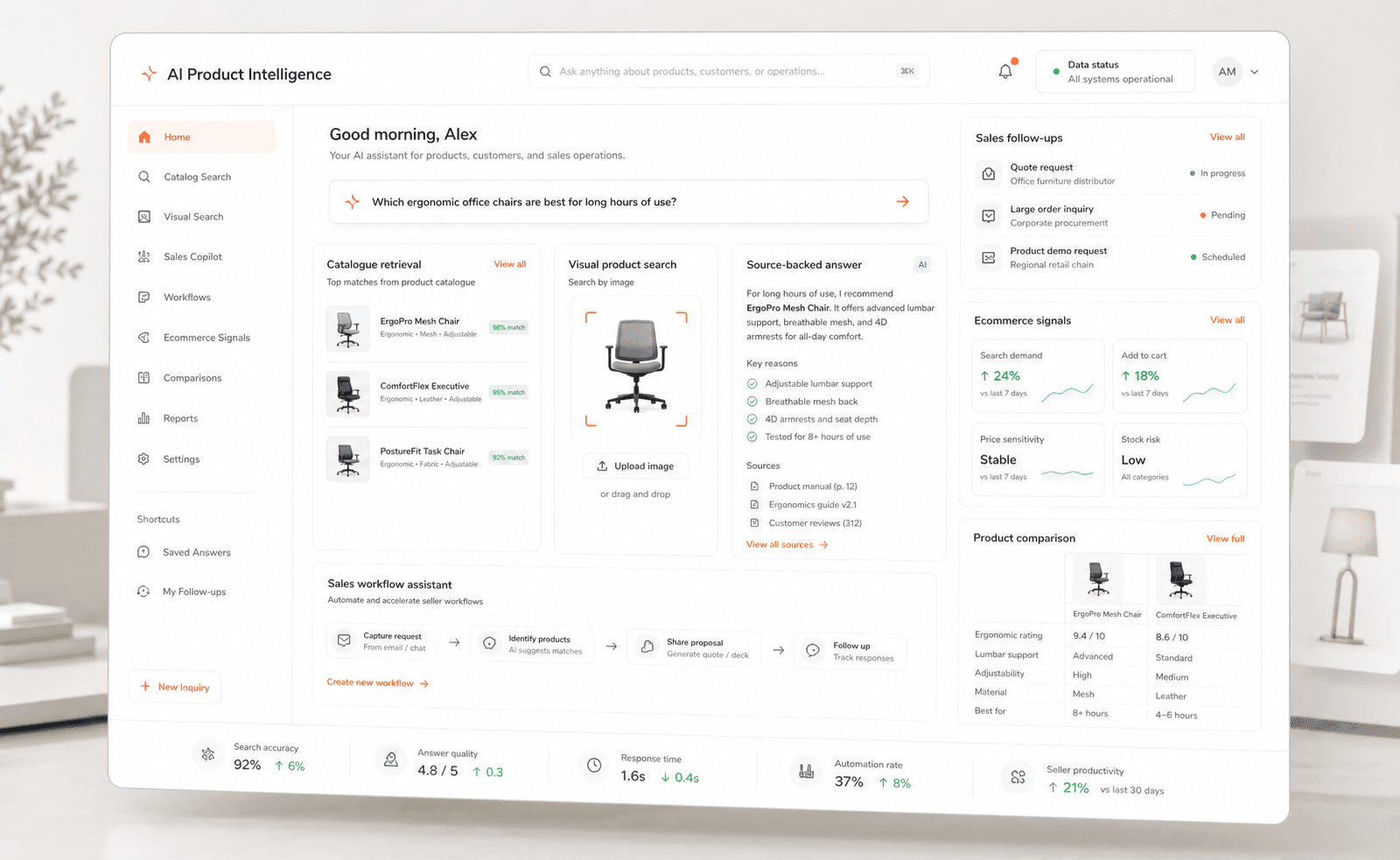
Aiera built a vision and retrieval layer for catalogue-heavy workflows, allowing teams to search, compare, and reason over product information with stronger context. CRM-style AI workflows helped sales teams qualify, follow up, and personalize outreach.
Ecommerce analytics and data collection tools connected customer behavior, product interest, and sales actions. Contact center automation handled routine service journeys and pushed exceptions to human teams.
The catalogue intelligence layer supported product discovery, comparison, and contextual retrieval. Teams could find the right item, understand specifications, and use source-backed answers in sales or support conversations. Where product visuals mattered, image-led retrieval helped users reason over visual and catalogue attributes together.
The AI-assisted sales workflows helped teams move from information retrieval to action. Leads could be qualified, follow-ups could be structured, customer context could be summarized, and next steps could be routed. This reduced the manual work around sales conversations without replacing the relationship-driven part of selling.
Dashboards connected ecommerce activity, product interest, customer segments, and operational follow-up. Instead of viewing ecommerce analytics separately from sales action, teams could understand which signals deserved attention.
How it was implemented
Implementation began with clean data boundaries and use-case prioritization. Each workflow was piloted with a specific team, measured against operational adoption, and then extended into adjacent processes.
Governance focused on source traceability, controlled recommendations, user permissions, and review loops so teams could trust the output.
The implementation started with the knowledge foundation: catalogues, product metadata, support content, sales process definitions, and analytics events. Aiera then built the first retrieval workflows around high-frequency product and customer questions.
Once teams validated the quality of responses, the system expanded into sales workflows and ecommerce analytics. This sequencing mattered. It prevented the organization from scaling AI before the source material, trust rules, and user behavior were ready.
Feedback loops were built into the workflow. Users could identify missing information, unclear answers, or poor recommendations. Those inputs helped improve source content, retrieval behavior, and dashboard design. Over time, the system became not just a tool for answering questions, but a way to improve the organization’s product knowledge.
The outcome
The organization gained a practical AI transformation model: smaller systems that improved daily work, created reusable data assets, and helped teams move from manual search and follow-up to AI-assisted execution.
Sales and support teams gained faster access to product information. Ecommerce and leadership teams gained better visibility into customer behavior and product interest. Operational teams gained a clearer path from insight to action.
The most important result was a transformation pattern the organization could repeat. Instead of waiting for one large platform to solve everything, teams could identify a high-value workflow, connect it to the intelligence layer, and expand from there.