AI Patient Operations Layer for a Multi-Specialty Healthcare Network
How a healthcare group used voice AI, clinical workflow automation, and AI-assisted documentation to reduce operational load across patient-facing teams.
The challenge
A multi-specialty healthcare organization was managing patient demand across phone, WhatsApp, web forms, internal teams, and in-clinic interactions. Routine enquiries, appointment changes, rehabilitation follow-ups, and documentation tasks were distributed across teams with different tools and handoff habits.
The leadership team did not want a disconnected chatbot. They needed a patient operations layer that could answer repeatable questions, support sensitive handoffs, preserve clinical context, and reduce administrative work without creating risk for doctors or care coordinators.
The pressure was felt in several places at once. Front-office teams were repeating the same information throughout the day. Care coordinators were chasing follow-ups manually. Doctors and clinical teams were losing time to documentation cleanup. Managers could see call volume and patient demand rising, but they did not have a reliable view of where delays were forming or which interactions required human attention.
The system also had to respect the realities of healthcare operations. A patient may ask a simple scheduling question and then mention something clinically sensitive in the same conversation. A rehabilitation update may look routine until a response indicates discomfort or non-compliance. A clinical note may be useful as a draft, but it still needs review and approval. The work required AI that knew its limits.
What Aiera took over
Aiera began with the operating journeys rather than the model. The first phase mapped patient intents, team ownership, escalation points, data dependencies, and the difference between administrative automation and clinical judgment.
The scope was then split into three workstreams: an omnichannel AI contact center, an AI rehabilitation avatar for guided follow-ups, and AI-assisted scribing for structured clinical notes.
For each workstream, Aiera defined the handoff rules before designing the AI experience. Which questions could be answered directly? Which conversations needed a coordinator? Which events required clinical review? Which fields could be updated automatically, and which could only be drafted for approval? These rules became the operating guardrails for the implementation.
The work also included knowledge preparation. Service information, appointment rules, location-specific instructions, common patient questions, escalation contacts, and rehabilitation follow-up prompts were organized into a maintainable structure. The objective was not simply to make the AI answer more questions. It was to make every answer traceable to a governed source.
The solution
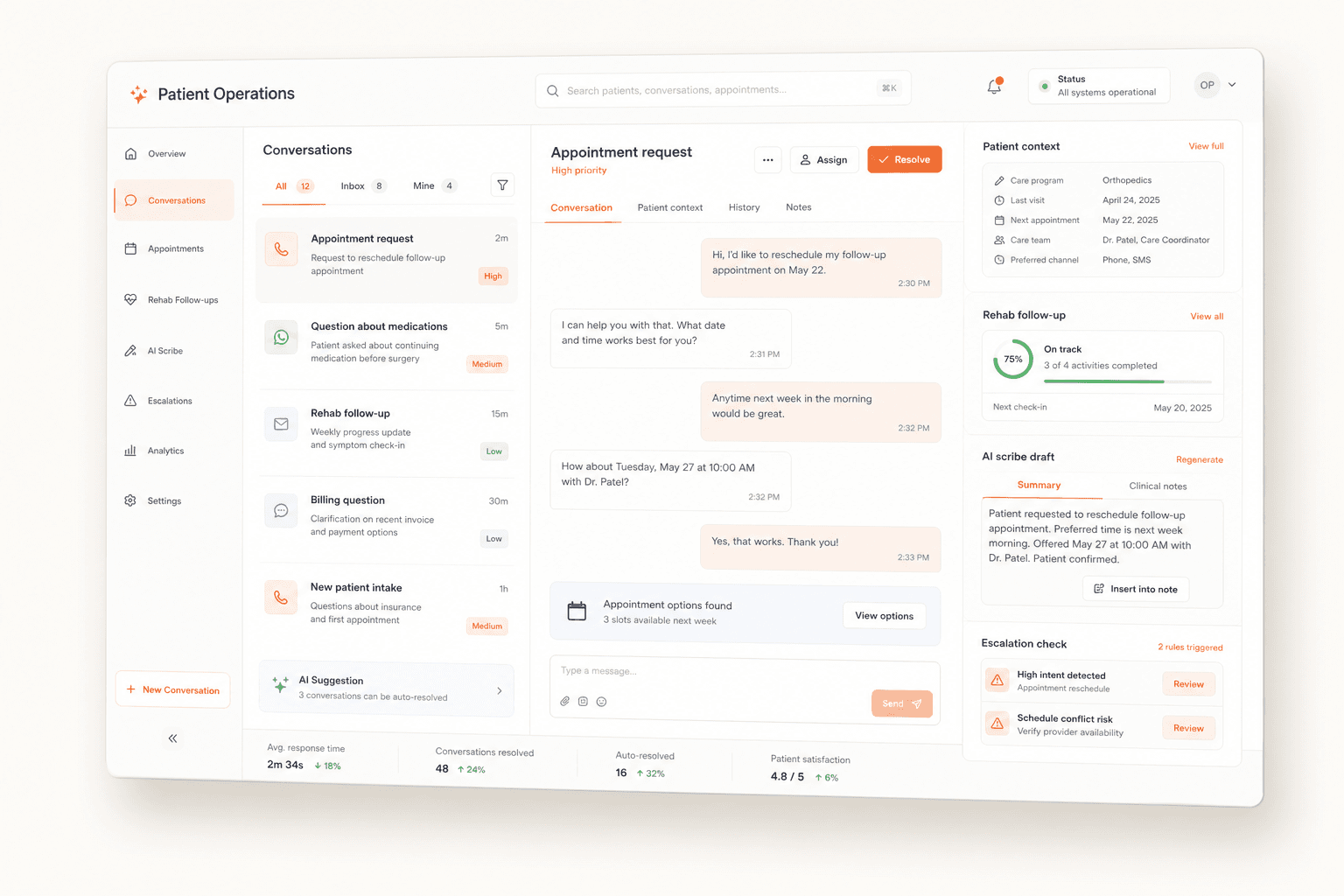
The contact center layer handled appointment requests, status checks, reminders, frequently asked questions, and structured routing. When the conversation required human intervention, the system passed the full context to the right team instead of restarting the interaction.
The rehabilitation avatar supported guided patient engagement between visits. It helped standardize follow-up prompts, collect patient responses, and flag exceptions that needed staff attention.
The AI scribing workflow converted conversations and clinician inputs into structured drafts that could be reviewed, corrected, and approved by authorized users.
Together, these systems created a shared patient operations layer. Routine interactions were handled consistently, but sensitive moments stayed human-led. Coordinators received structured context rather than fragments. Managers could see demand by journey, not just by channel. Clinical teams received AI-supported drafts rather than unstructured notes that had to be rewritten from scratch.
The dashboards were designed around operational questions: where are patients waiting, which intents are driving volume, how many interactions need human follow-up, where are handoffs ageing, and which journeys are creating avoidable repeat contact?
How it was implemented
Aiera deployed the system in controlled stages. Initial pilots focused on high-volume, low-risk journeys. Governance rules defined what the AI could answer, when it had to escalate, and which fields could be written back to operational systems.
Dashboards gave managers visibility into volume, routing, unresolved cases, exception reasons, and adoption across teams. Training focused on human-in-the-loop operation, not just tool usage.
The first release handled a narrow set of common enquiries and appointment workflows. Once teams were comfortable with the handoff model, the scope expanded into reminders, rehabilitation follow-ups, and scribing support. Each expansion added more value without changing the core operating principle: AI handles repeatable work, humans own judgment.
Review loops were built into the rollout. Coordinators and managers could identify unclear answers, repeated exceptions, and missing knowledge. Those signals were used to improve prompts, source content, routing rules, and dashboard views. This made the system stronger over time and gave teams a clear way to influence adoption.
Security and access were treated as implementation requirements, not later-stage cleanup. Different users saw different levels of detail, clinical drafts remained reviewable, and sensitive conversations were routed with appropriate context.
The outcome
The organization gained a more consistent patient communication layer, clearer exception management, and lower dependence on manual coordination for repeatable work. Care teams retained control of clinical decisions while AI absorbed the operational burden around them.
Patient-facing teams could respond with more consistency across channels. Coordinators had better context before intervening. Rehabilitation follow-ups became easier to standardize and monitor. Doctors and clinical staff received better-structured documentation support without losing review control.
Most importantly, the organization moved away from isolated automation and toward a governed operating model for healthcare AI. The result was not a bot sitting outside the workflow. It was an AI-supported layer around patient communication, documentation, follow-up, and operational visibility.