AI Credit and Market Intelligence Layer for an Agri-Finance Platform
How an agri-finance organization used voice AI, video-led due diligence, and predictive market signals to improve field and credit workflows.
The challenge
An agri-finance platform serving distributed customers and supply-chain participants needed better visibility into borrower context, market movement, and field-level signals. Traditional follow-ups were slow, documentation was inconsistent, and credit teams needed more structured evidence before making decisions.
The business needed AI that could work in real operational conditions: phone-first users, field teams, variable data quality, and decisions that carry financial risk.
The operating environment was complex. Customers and field teams often worked through voice, video, WhatsApp, and documents rather than clean digital forms. Personal discussions could contain important context, but that context was difficult to standardize. Market information could shift quickly across commodities, locations, and supply-chain participants. Credit teams needed evidence, not just summaries.
The organization wanted AI to improve speed and consistency, but not to remove accountability from credit decisions. The system had to support human judgment, strengthen documentation, and help teams identify where attention was needed most.
What Aiera took over
Aiera mapped the credit and field journey from enquiry and verification to personal discussion, documentation, market context, and decision support. The focus was on building stronger evidence trails, not automating credit judgment blindly.
The design separated customer interaction, field intelligence, market signals, and human approval.
This separation was critical. Voice AI could collect and confirm information. Video-led workflows could structure field observations and personal discussion inputs. Predictive analytics could surface market movement and risk signals. Credit teams could then review the evidence and make accountable decisions.
Aiera also mapped the points where data quality broke down: incomplete field notes, inconsistent borrower context, missing follow-up, informal market observations, and documents that were difficult to compare. These became the first areas of intervention.
The solution
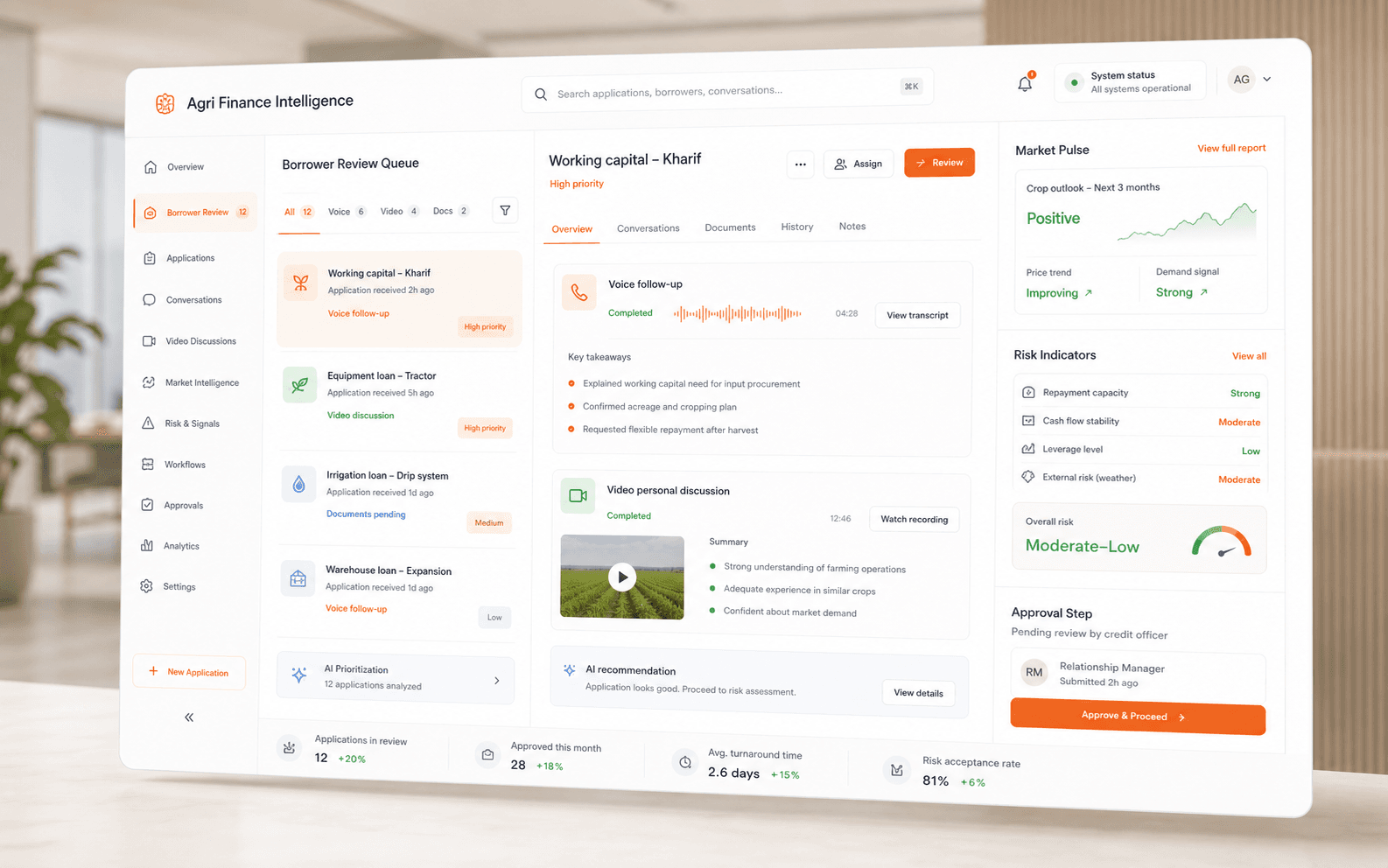
Voice AI supported structured conversations and follow-ups. Video-led personal discussion workflows helped capture richer borrower context and convert unstructured field inputs into reviewable records.
Predictive analytics created market pulse signals from available operational and external indicators. Dashboards helped teams see patterns, exceptions, and risk context before escalation or approval.
The voice layer helped teams handle repeatable conversations: enquiry capture, status checks, reminders, missing information, and follow-up prompts. The goal was not to make every customer interaction automated. It was to make important interactions more structured and less dependent on memory.
The video personal discussion workflow created a richer evidence layer. Field inputs, borrower context, business observations, and discussion notes could be structured for review. This gave credit teams a more consistent way to evaluate context that would otherwise remain scattered across calls, messages, and field notes.
The predictive layer added market awareness. Signals from operational data, customer activity, and market indicators helped teams understand where risk or opportunity was changing. Dashboards connected these signals to review queues, giving teams a way to prioritize attention.
How it was implemented
Aiera deployed the workflows around existing credit operations, starting with structured data capture and review queues. The predictive layer was introduced as a decision-support signal, not as a standalone approval engine.
Teams were trained to use AI outputs as evidence, ask better follow-up questions, and preserve accountability for final decisions.
The implementation began with journey mapping and data capture design. Aiera worked through what information was required for each stage, which data could be collected through voice, which required field input, and which needed human review.
The first release focused on standardizing conversations and review queues. Once teams were comfortable with the structure, video-led workflows and market pulse indicators were added. This reduced adoption risk and allowed the organization to validate each layer before expanding.
Governance was built around credit accountability. AI outputs were treated as support material. Recommendations and signals were visible, but approvals remained with the right users. Reviewers could see source context, missing information, and exception flags before taking action.
The outcome
The platform gained a stronger intelligence layer for field, credit, and market workflows. Teams could capture cleaner inputs, review richer borrower context, and use predictive signals to prioritize attention where risk or opportunity was changing fastest.
Field teams gained more structured ways to collect and submit information. Credit teams received cleaner evidence trails and better context. Leadership gained visibility into market pulse, workflow ageing, and exception patterns.
The larger outcome was a more disciplined operating model for AI in agri-finance: automate the repeatable, structure the messy, surface the signals, and keep financial judgment accountable.